NeuroRad Atlas · Research and education
Neuroradiology literature,
organized around the questions.
A selected evidence map connecting claims, disagreements, source papers, and proposed studies. Examine the literature behind a question and develop a research brief suited to your setting.
Selective coverage. Human-reviewed updates. Assessments are provisional and do not replace critical appraisal.
Currently mapped
Current coverage
Selected topics in brain/glioma, spine, and head and neck imaging.
— nodes · — edges · — papers — published collection
Atlas does not index every paper or every topic. Topics are included when they meet at least two of four criteria: clinical decision-relevance, active disagreement, standardization pressure, and public data availability.
Evidence example
Can routine MRI predict MGMT methylation?
Follow the recorded claim through supportive and contradictory studies. Inspect validation settings and the limits of the Atlas assessment before interpreting the result.
01 · Evidence
Read the studies in context
The Atlas links reported associations, challenges and validation limitations. A connection is an interpretation that can be checked against the source.
Open the claim and sources →02 · Question
Identify what remains uncertain
Review the proposed question and study direction. Confirm that the apparent gap remains open in a current literature search.
Review the research question →03 · Study
Define a feasible project
Record your timeline, data access, comparator, outcome and limitations. Save a local draft or download a brief for discussion with a mentor.
Prepare a research brief →Evidence connections
Inspect a question and its immediate context.
The graph opens on a focused set of relationships. The complete map remains available for broader exploration.
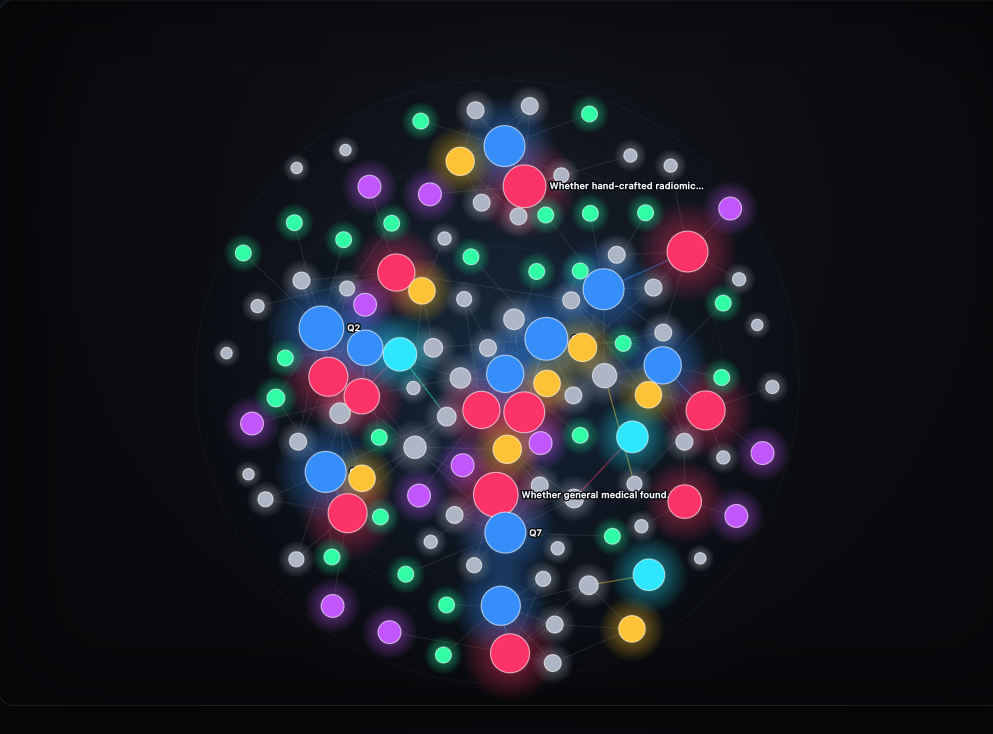 Concepts and their recorded relationships. Open the interactive graph →
Maintenance
Monthly surveillance, reviewed before inclusion.
Editorial maintenance and review: E. Brooke Schrickel, MD.
New literature is screened for relevance to existing claims. Proposed additions require human review. The update history records applied cycles, rejected suggestions and changes to the collection; it does not establish exhaustive coverage.
Interpreting the Atlas
Evidence profiles show source coverage and appraisal status. Historical grades remain visible for comparison; new grades require documented source appraisal and review. They are not probabilities or a formal GRADE assessment. Missing coverage is not proof of a research gap. Methods, provenance and limitations
Research and education only; not for individual patient management.